TLDR: A portable office pod ships on a standard pallet, assembles in hours without a permit, and can be broken down and relocated later. The real difference between a cheap pod and an expensive one comes down to acoustics, ventilation, and materials, not size. This guide compares pods against phone booths, prefab buildings, and built-out rooms, breaks down pricing by configuration, and flags the situations where a pod isn’t the right call.
At a Glance:
- A pod only counts as “portable” if it disassembles without tool damage, ships on standard freight, and skips the permit process. Anything requiring a foundation or crane belongs in the modular building or permanent category.
- Acoustics, ventilation, and materials drive cost more than square footage. Two similarly sized pods can vary widely in price and long-term durability based on these three factors alone.
- Single-person, two-person, and four-person configurations each fit different use cases, and add-ons should be confirmed for compatibility before ordering.
- Renting suits short-term or pilot projects; buying makes more sense for a fixed, multi-year workspace need.
Most offices don’t need a construction crew to modernize. They need a quiet box that shows up on a pallet, goes together in an afternoon, and can move again next year without a demolition permit.
That’s the entire premise of a portable office pod: a self-contained workspace built to assemble without tool damage, ship on standard freight, and set up in hours instead of weeks.
The catch is that not every pod earns that description equally well. Two units can look nearly identical online and behave completely differently after six months of daily use, and the gap almost always traces back to three things: the materials, the ventilation, and the acoustic rating. Cheap pods cut corners in exactly those three places.
The comparison below sets portable office pods against phone booths, prefab buildings, and built-out rooms. Use it to figure out which format actually fits your space, your budget, and how often you plan to move it.
What Makes an Office Pod “Portable”?
A pod earns the word “portable” when it clears a specific test, not a marketing claim:
- It disassembles without damaging tools or the pod itself.
- It ships on standard pallets using common freight carriers, not specialty transport.
- It reassembles in hours with a small crew, not days with a contractor.
- Building codes classify it as furniture rather than construction, so it typically doesn’t require a permit.
- It doesn’t anchor to the building structure.
Some manufacturers use “mobile office pods” or “portable workspace pod” interchangeably with this term. The label matters less than whether the unit actually meets the test above.
Modular Doesn’t Always Mean Portable
“Modular” gets used for two very different products, and that’s where buyers get tripped up. Panel-based modular pods, like YOURspace’s, are built from repeatable components specifically so they can be reconfigured, expanded, or relocated without a foundation, a crane, or a permit.
Large-scale modular buildings use the same word but describe something closer to prefab construction: units built off-site, then craned into place and permanently installed with a foundation and utility hookups.
The word “modular” tells you how something is built. It doesn’t tell you whether it’s portable. A pod can be both, built from modular components and still light enough, and self-contained enough, to ship, assemble, and relocate on its own.
The question to ask a manufacturer isn’t whether a product is modular. It’s whether it needs a foundation, a crane, or a permit to go anywhere.

Portable Office Pods vs. the Alternatives
Facilities managers usually weigh a pod against three other formats: the office phone booth, the prefab or modular building, and a conventional built-out room. Each solves a different problem, and the right choice depends on timeline, budget, and how often the space needs to change.
A phone booth handles quick calls and one-person privacy but rarely supports a full workday. A prefab or modular building offers more square footage and often costs more upfront, with a longer install timeline. A built-out room delivers permanence at the highest cost and the least flexibility once built.
Office pods buying guide:
A pod wins when the need is flexible and the timeline is short. A built-out room wins when the headcount and the location are both fixed for years.
Seven Things to Check Before You Buy
1. Assembly Time and Crew size
Ask the manufacturer for a documented install time and the number of people it takes. YOURspace pods typically take around two hours to install, with the work of at least two individuals.
A pod that “installs fast” without a number attached usually means it hasn’t been timed.
2. Freight Format: Pallet vs. Flatbed
Freight format changes the cost more than almost any other factor. A pod that ships on a standard pallet moves through common carriers at standard rates. A pod that requires a flatbed or specialty freight adds cost before it ever reaches the loading dock.
3. Acoustic Performance
A decibel reduction figure describes how much sound the pod blocks, not how quiet the room feels. Two pods with the same dB rating can feel very different depending on wall thickness, door seal, and ventilation noise.
Ask for a rating with a testing method attached, not just a number.
4. Ventilation and Climate Control
A pod with poor airflow becomes uncomfortable within an hour of continuous use, regardless of how good the acoustics are.
Ask whether the ventilation system runs independently of the building’s HVAC, and whether it includes active climate control or passive airflow only.
5. Power, Data, and Lighting
Confirm outlet count, USB or USB-C ports, ethernet pass-through, and lighting type before ordering. Dimmable LED lighting matters more over an eight-hour workday than it looks like on a spec sheet.
6. Reusability and Relocation
Ask how many times a pod can be disassembled and reassembled before the panel connections wear out. A pod rated for one-time assembly isn’t truly portable, whatever the marketing says.
7. Materials, Certifications, and Sustainability
Ask whether the materials contribute toward LEED certification and whether the manufacturer can document the material sourcing. Using a pod made in the USA can ease the process of inquiring about compliance requirements.
Sizes and Configurations
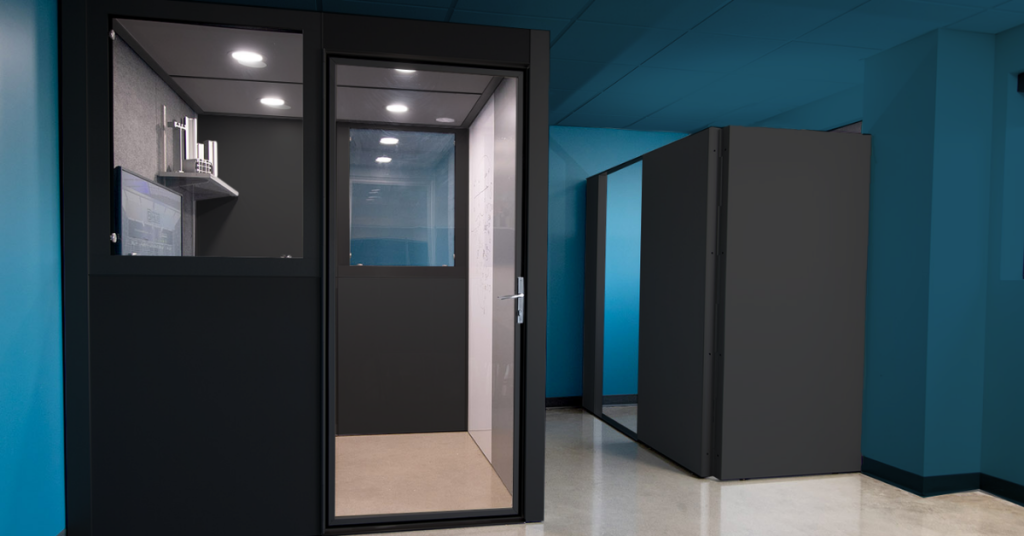
Portable office pods come in single-person, two-person, and four-person configurations. A single-person pod fits one desk for focus work and calls, a two-person pod adds room for a short meeting, and a four-person meeting pod handles team huddles and video calls. For exact dimensions, floor space per person, and starting prices for each size, see our office pod size and capacity guide.
Size also affects portability. Larger pods have a bigger footprint and may ship in a different freight format, so confirm door width, ceiling clearance, and elevator dimensions before ordering.
What Portable Office Pods Cost
Prices vary depending on size, finishes, add-ons, and brand. YOURspace portable office pods for sale start at $5,800 dollars and increase as the configuration becomes larger and more complex.
The price gap between a cheap pod and an expensive one rarely comes down to size alone. It comes down to acoustics, ventilation, materials, and warranty length. A budget pod might match a premium pod on footprint and still cost less to build because it uses thinner panels, a passive ventilation system, and a shorter warranty.
Renting instead of buying can also make sense for short-term projects or trial deployments. See YOURspace’s quick ship options for faster turnaround on either path.
When a Portable Office Pod is the Wrong Choice
A pod isn’t the right answer in every situation, and buyers should rule these out before ordering.
- Permanent headcount growth. If a team is adding fixed positions for years, not months, a built-out room or a modular addition amortizes better over time.
- Spaces that need plumbing or fixed HVAC beyond a pod’s built-in system. A pod solves acoustics and light climate control. It doesn’t replace plumbed fixtures or building-integrated HVAC.
- Buildings with ceiling height or freight-elevator constraints. Confirm door width, ceiling clearance, and elevator dimensions before ordering. A pod that can’t get through the freight elevator becomes an expensive delivery problem, not a workspace.
If a general contractor or project manager is sourcing for a construction site rather than an office, a portable office for construction sites is usually the better-fit product.
Ready to Configure a Pod?
Most of what separates buying the best pod from one that’s good enough comes down to knowing the numbers. Once you know what to ask for from office pod manufacturers, the comparison gets a lot easier.
Talk to YOURspace about specific dimensions, acoustic ratings, and lead times for your space, or shop office pods by size and pod add-ons to start narrowing down what fits.
FAQs
Which office pods offer sink add-on options?
Sink add-ons are available on select pod sizes, typically break-room or wellness-room configurations. Confirm compatibility with the manufacturer before ordering, since not every size supports a plumbed add-on.
Does pod size affect how easy a pod is to move?
Yes. Smaller pods move and reassemble with less effort, while larger meeting pods take up more floor and truck space. Assembly is tool-free at every size and typically takes two people about two hours. Not sure which size you need? Check how many people each pod size fits before you order.
Are office pods easy to install and relocate?
Most portable pods install in hours with a small crew and don’t require a permit. Relocation works the same way in reverse: disassemble, freight, and reassemble at the new site.
Is it better to rent office pods than to buy them?
Renting fits short-term projects, pilot deployments, or uncertain headcount. Buying makes more sense for a permanent workspace need with a multi-year timeline.
Which office pods are the best quality?
Quality comes down to the manufacturer’s documented specs: assembly time, dB rating with testing method, ventilation type, and warranty length. YOURspace is a trusted source of quality office pods.
Is a portable office pod a cost-effective investment for a small office?
It depends on the alternative. Compared to a built-out room, a pod typically costs less upfront and installs faster. Compared to doing nothing, the cost only pays off if the noise or privacy problem it solves is actually affecting the team’s work.
Related Links
- Office Pods
- What Size Office Pod Do You Need? A Capacity Guide by Use Case
- Building and Renovating Space
- How Modular Office Pods Enhance Workplace Sustainability
- 5 Ways Office Fitouts Deliver ROI
- How Temporary Office Pods Adapt Year-Round
- Why You Need to Modernize Your Space With Office Fitouts
- 6 Great Reasons Why Office Pods Are Beneficial
- Office Pod Features
- Shop Custom and Quick Ship Pods
- Get Yours